The hills of the West Riding
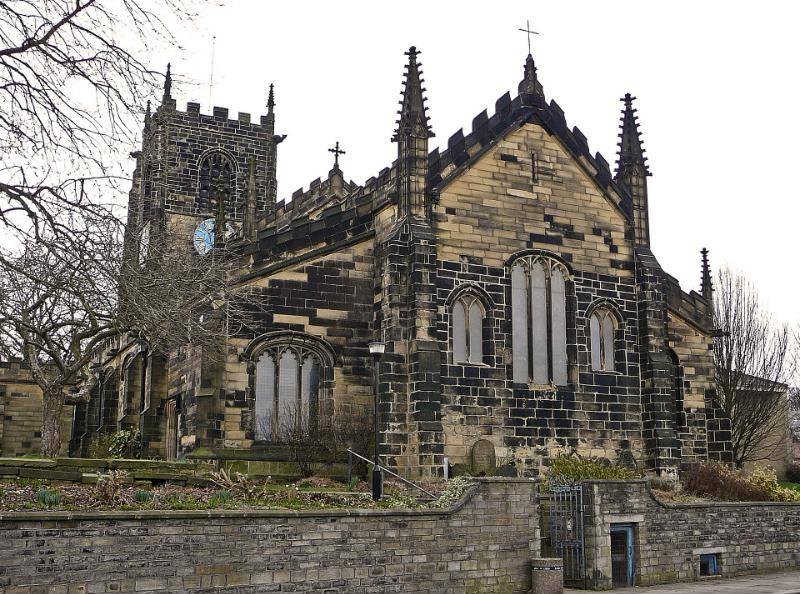
Picture steep green hills on the eastern side of the Pennines, the spine of northern England. Stone farmhouses sit on the slopes and fast streams run in the valley bottoms. Around Huddersfield and the hilltop village of Almondbury, families farmed small holdings and wove wool cloth at home, then carried it to market.
This is where the family most likely came from. In England the name was usually spelled Kay or Kaye, and it was said with a long “a,” so that it rhymed with “grey.” When Martin Key signed a Virginia petition in 1696, he still wrote it “Martin Kay.” Early DNA tests matched the family historian Marcus Key to Kay and Kaye men from Huddersfield, Almondbury and Bury.
A parish of hamlets
The parish register of Almondbury, read page by page for 1626 to 1650, names Kay households in a dozen hamlets around the church: Farnley, Ewes, Newsome, Cross, Lockwood, Marsden, Netherthong and more. At Farnley alone there were four John Kays at once, and the clerk told them apart by their fathers’ names, “John son of Henry” and “John son of Richard.” None of them is ever given a title; the Kayes of Woodsome Hall and Denby Grange, who were, are another family.
The hamlet that matters most is Ewes, below the church. A John Kay of Ewes baptised a daughter Susanna in 1631, a son John in 1635 and a son William in October 1639, and then he and his children disappear from the register. On the 1668 Virginia list there is a John Key senior, a John Key junior, a William and a Susan. His neighbour William Kay of Ewes had a son Abraham in 1639, and there is an Abraham on the list too. It is the strongest lead we have for where John Key Sr. came from, and it is still a lead, not a proof.
The great winter
The register also records a hard winter. At the end of 1634 the vicar wrote that snow lay so deep nobody could get to the corn mill or the butchers, that travellers died in the drifts, and that men carrying a corpse to church were snowed in at Honley overnight. It was, he said, the greatest and longest winter anyone remembered.
The silent years
Then the war came. The vicar died in June 1644, three weeks before the battle of Marston Moor, and his successor wrote that, “the war between King and Parliament then raging,” the church had only hired ministers until 1647. For three years the register is almost blank. If a Kay family left Almondbury for the coast in those years, nobody wrote it down.
The brother who stayed
Not everyone went. On 13 June 1668, six weeks after the Virginia patent that lists the eleven Keys, Edmond Key of Newsome, a hamlet of the same parish, made his will. He could not write and signed with his mark. He left ten pounds to a girl named Susanna Kay alias Spence, a shilling each to “Peter Kay my brother” and to four married women, and everything else to “Grace my loving wife.” He was buried two days later. His will shows the Almondbury clerks were already writing the name as Key, and that at least one Edmund Kay stayed in Yorkshire while another Edmund Key was in Virginia.