Neighbours of the Jeffersons
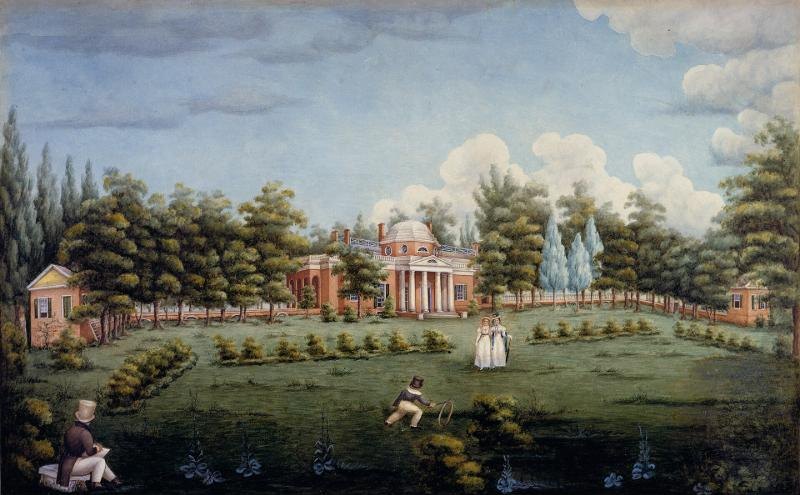
John Key was on the Rivanna before the Jeffersons. He patented his land in 1732; Thomas Jefferson later wrote that his father Peter was “the third or fourth settler, about the year 1737.” A 1734 patent ran along the river “from Shadwell Branch to Key West,” the Jefferson home at one end and the Key home at the other.
On 30 June 1740 John Key sold 145 acres beside William Randolph’s land to the Rev. William Stith, a clergyman who was a first cousin of Peter Jefferson’s wife, Jane Randolph, and who later wrote one of the first histories of Virginia and became president of the College of William & Mary. Three men watched John sign his name: Henry Wood, Charles Lynch and Peter Jefferson. On 15 July Peter Jefferson stood up in the Goochland court and swore to it. This is the one record that names the two families together, three years before Thomas Jefferson was born. Both men served the new county: John as militia ensign and road surveyor, Peter as one of its leading officers. They almost certainly knew each other well, though no other record shows it.
Thomas Jefferson grew up at Shadwell from about the age of nine, a short ride from Key West. In 1764, when the parish had neighbours walk their property lines, John Key was there for his own boundaries, and the same record lists lines belonging to Thomas Jefferson, then just twenty-one.
The ties carried on in the next generation. John’s elder son Martin built an estate of about 3,000 acres that adjoined Jefferson’s land on the other side of the Southwest Mountain, and in 1777 Governor Patrick Henry commissioned him the first sheriff of Fluvanna County. After Martin died in 1791, his widow Ann went on selling corn, oats and fowls to Jefferson until 1804. Martin’s son, Captain John Key, managed Monticello as Jefferson’s steward from 1782 to 1784 while Jefferson was at the Continental Congress, keeping the accounts and supervising the overseers of the people enslaved there. Martin and the steward are cousins of the direct line, which runs through Martin’s younger brother John.
Jefferson’s surviving notes read like a to-do list for the steward: provide clothing and blankets, sell the grey horses for £50, take the broken-legged horse off the plough, and once Jupiter and Charles finish the canal, build a house beside the new shop. Jupiter and Charles were among the people Jefferson enslaved. “Agreed with John Key to serve me as steward another year for £80,” Jefferson wrote in September 1783.
The direct line knew Jefferson too. In May 1768 Henry Key of Amherst, brother of John Key Jr. and uncle of John Waller Key, went to the young lawyer about a neighbour who had said Henry “stole a cow belonging to John Harmer his employer.” Jefferson took the slander case and noted, “I am to charge no fee.” He advised Henry in a second case the same day and charged 20 shillings.